 By admin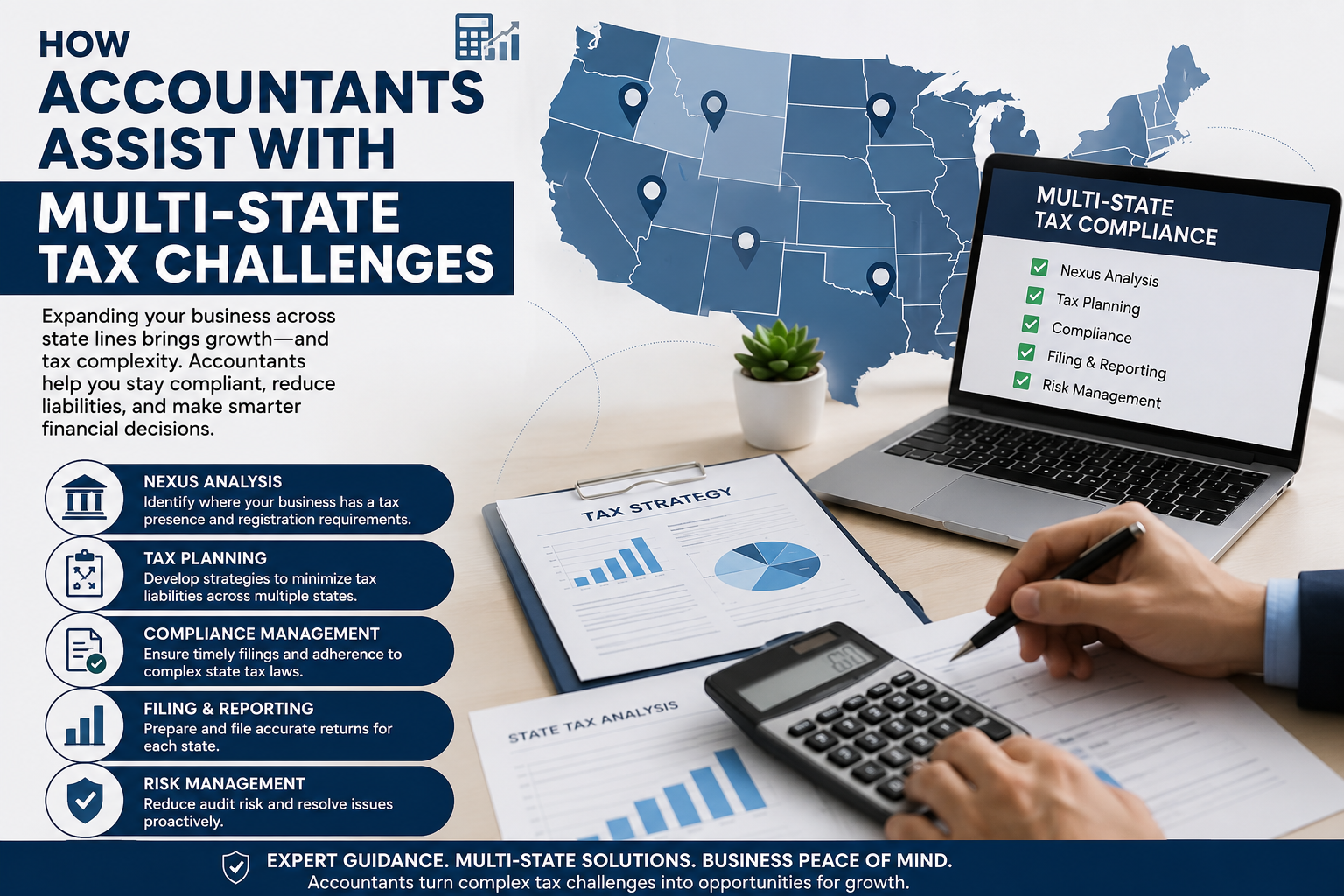
You might be feeling like your business outgrew your tax comfort zone overnight. One extra remote employee here, a few online sales there, and suddenly you are getting tax notices from states you barely remember driving through. What used to be one simple tax return now feels like a maze of rules, deadlines, and forms that do not seem to match each other, and you are starting to realize you may need professional tax services in San Jose, CA.
It often starts with something small. You hire a great employee who happens to live in another state. Or your online sales begin to pick up, and now you are shipping across the country. At first it feels exciting. Then the questions start. Do you owe income tax there? What about payroll withholding? Sales tax. Nexus. And if you are honest, you might worry that you are already out of compliance and just do not know it yet.
You are not alone in that feeling. Multi-state tax rules are confusing even for people who work with numbers every day. The good news is that with the right help, this chaos can be turned into a clear plan. This is where an experienced bookkeeping and tax accountant becomes less of a luxury and more of a safety net. In simple terms, a good accountant helps you figure out which states you actually owe, how much you owe, and how to stay ahead of the rules so you are not waiting for the next scary letter to show up.
So, where does that leave you? You do not need to become a tax expert in fifty different states. You do need to understand the main problem areas, what is at stake, and how a steady professional can guide you through multi-state tax challenges without turning your life upside down.
Why multi-state tax gets messy so quickly
The core problem is that every state wants a fair share of your income or your business activity, yet they all define “fair share” in different ways. There is no single national rulebook that cleanly settles everything. There are federal guidelines and model rules, but states often interpret or apply them differently.
Because of this tension, you might wonder where your responsibility truly begins. A few common triggers create multi-state tax problems.
First, remote employees. If you pay someone who lives and works in another state, that state often expects payroll tax withholding, unemployment contributions, and sometimes even business income tax filings. The IRS gives general payroll guidance in resources like Publication 15 (Circular E), yet each state adds its own twist.
Second, sales across state lines. Selling products or services into other states can create “nexus,” which is the legal connection that allows a state to tax you. Nexus can be economic, like reaching a certain level of sales or number of transactions in a state, or physical, like storing inventory or having a contractor there.
Third, conflicting rules. States may disagree about how much of your income belongs to them, or how to source your revenue. You can end up with the same dollar of income taxed in more than one place if you are not careful with credits, apportionment, and filing methods.
This is where the agitation starts. Notices arrive demanding back taxes, penalties, and interest. Refunds you expected are held up because another state is asking questions. You lose hours trying to interpret language that sounds like it was written for lawyers, not for people trying to run a business.
How does an accountant help with these multi-jurisdiction headaches? A skilled professional does not just fill out more forms. They step back and map your footprint. Where are your employees? Where are your customers? Where is your inventory? Then they match that reality to each state’s rules so you only file where you truly need to, and you file in a way that reduces double taxation and surprises.
How accountants bring order to multi-state tax challenges
Think of a seasoned accountant as your translator between your day-to-day operations and the web of rules that different states use. Their role covers several layers of protection and planning.
First, they identify where you have nexus. An accountant will review your payroll, sales, shipping records, and service agreements to determine which states you actually have filing obligations in. They will consider current rules and watch for changes, using resources such as the Multistate Tax Commission as a reference point for standards and guidance.
Second, they design a filing strategy. Multistate income often needs to be divided among states using formulas based on sales, property, and payroll. A thoughtful approach to apportionment and credits can reduce double taxation. The wrong approach can do the opposite.
Third, they coordinate payroll and sales tax. Payroll in multiple states means registration, withholding, and reporting in each of those states. Sales tax in multiple states means tracking thresholds, product taxability, and exemptions. An accountant can link your bookkeeping systems to your tax filing requirements so data flows correctly and you are not retyping numbers under stress.
Fourth, they clean up past exposure. If you discover that you should have been filing in another state for years, a good accountant can help you assess the damage and often use voluntary disclosure or amnesty programs. This can reduce penalties and limit how far back a state can go, which can be the difference between a manageable catch-up payment and a crisis.
Finally, they help you plan ahead. Before you hire another remote employee or open a new sales channel, an accountant can model the tax impact. You can then choose the structure that supports growth without creating unnecessary complexity.
So, what are your options when you are facing multi-state tax issues and trying to decide whether to handle this alone or seek help?
Should you handle multi-state taxes yourself or hire help
There is nothing wrong with trying to manage taxes on your own when your situation is simple. When multiple states get involved, the risk of unintended mistakes grows quickly. The comparison below can help you think this through.
| Approach | What It Looks Like In Practice | Main Risks | Main Benefits |
| DIY multi state tax filing | You research each state’s rules, register for accounts, track thresholds, and file income, payroll, and sales tax returns yourself using general software or state websites. | Missing nexus triggers, late or missed filings, double taxation, inconsistent data across states, more audits, and time pulled away from running your business. | Lower out-of-pocket cost, more direct control, deeper personal understanding of your tax footprint. |
| Using general tax software only | You rely on software prompts to add states, but you decide which states to include and how to split income and payroll between them. | Software cannot fully interpret your facts, may not flag all state-specific rules, and might give a false sense of security if answers are entered incorrectly. | Faster than pure DIY, automated math, some guidance on basic multi-state scenarios. |
| Working with a multi-state tax accountant | You share your operations, payroll, and sales data. The accountant maps nexus, designs your filing strategy, handles registrations and returns, and monitors changes each year. | Professional fees and the need to share detailed, accurate information in a timely way. | Reduced risk of penalties and double tax, coordinated filings, fewer surprises, and more time to focus on the business itself. |
When you look at it this way, the question becomes less about whether you are “smart enough” to do it, and more about where your time and energy are most valuable, especially when the cost of a mistake can linger for years.
Three practical steps you can take right now
1. Map your current multi state exposure
Start with a simple list. Which states do you have employees in? Where are your customers? Where do you ship products? Where is your inventory or equipment? Which states are already sending you tax notices or forms? This does not need to be perfect. Even a one-page snapshot gives an accountant or your internal team a clear starting point for addressing multi-state tax challenges.
2. Bring your bookkeeping in line with your footprint
Your books should reflect the way your business actually operates across states. That means tracking revenue by customer state, payroll by employee location, and any significant assets or inventory by state. Many accounting systems can be customized to capture this data. A thoughtful bookkeeping setup makes it much easier for a tax professional to prepare accurate multi-state returns and reduces the chance of conflicting numbers between states.
3. Have a focused conversation with a tax professional
You do not need to commit to a long relationship to get clarity. Schedule a targeted consultation with someone experienced in multi-state work and be upfront about your concerns. Ask where they see the greatest risk, which states matter most for you right now, and what they would prioritize in the next 3 to 6 months. Even one well-structured conversation can turn a vague sense of dread into a clear plan, and it will help you decide whether you want ongoing help with your multi-state tax and general tax accounting needs.
Bringing your multi-state taxes back under control
Multi-state tax issues have a way of making capable people feel scattered and behind. The rules are not intuitive, and you are juggling them while also trying to serve customers, support employees, and keep the business moving forward. Feeling worried or even embarrassed about what you might have missed is completely human.
You do not have to untangle this alone. With the right support, multi-state tax work becomes a manageable part of your routine rather than a constant source of stress. A steady, experienced accounting partner can connect your daily operations to the tax rules that apply, so you know where you stand and what comes next.
The most important step is the first one. Take stock of where you are, gather your information, and reach out for guidance when you are ready. Over time, what feels overwhelming today can turn into a clear, repeatable process that supports your growth instead of holding it back.