 By admin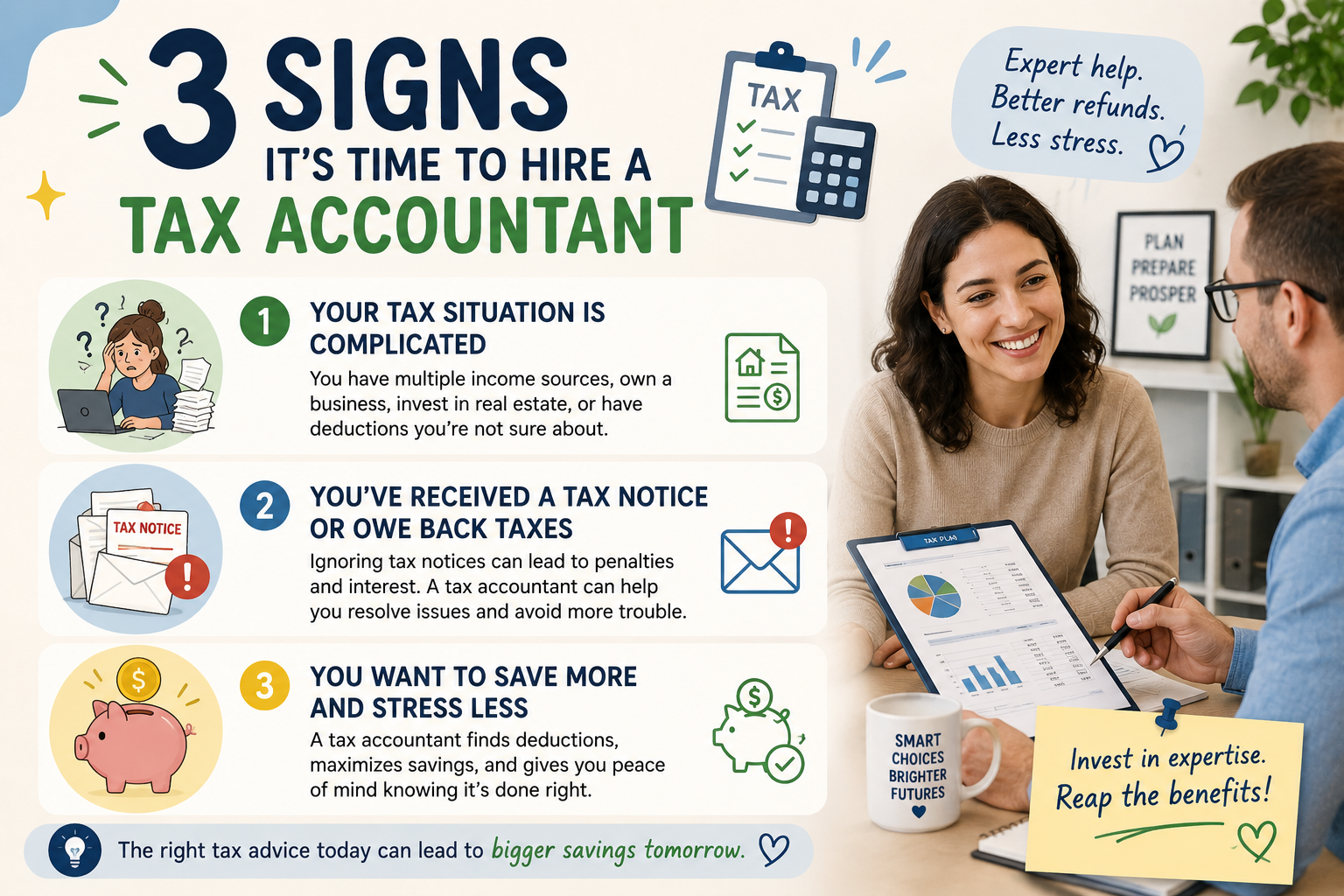
You might be staring at a half-finished tax return, a pile of unopened envelopes, and a browser full of confusing tax articles, wondering how something that used to feel simple has become so heavy. Maybe you used to file your own return with no trouble. Now there are new forms, new income sources, a Nassau County tax advisor to consider, or a tax letter from the IRS that makes your stomach drop.end
If that sounds familiar, you are not alone. Many people reach a point where “doing it yourself” stops feeling smart and starts feeling risky. You do not have to be wealthy or own a big company to reach that point. Sometimes the smartest move is to bring in a professional and protect your peace of mind.
This is where understanding the 3 signs it’s time to hire a tax accountant can give you clarity. In short, you might need help if your tax life has become complex, if you feel real fear about making a mistake, or if your time is simply too valuable to keep wrestling with the numbers. Once you see those signs clearly, the decision gets much easier.
Are your taxes more complicated than they used to be?
It often starts with one change. You buy a rental property. You start a side business. You receive stock options or restricted stock units. At first you think, “I can still handle this.” Then tax season arrives and you are trying to understand schedules, basis calculations, and rules that seem to change every year.
Because of this tension, you might wonder if you are missing deductions or making mistakes that could lead to penalties. The IRS has very specific rules about reporting income and claiming credits. Their own guidance on accuracy-related penalties shows how easy it is to get into trouble if you guess or rely on half-understood advice from the internet.
Here are a few situations where complexity tends to jump quickly.
Imagine you started driving for rideshare apps and also sell items online. Now you have multiple 1099 forms, business expenses, and maybe quarterly estimated taxes. A simple W-2 return has turned into small business reporting. Or imagine you own a rental condo. Suddenly you are tracking repairs, depreciation, mortgage interest, and local rules. The tax code treats each of these differently, and what looks like a small decision today can affect you for years.
When the rules become this layered, a professional tax preparer is not a luxury. It can be a way to avoid paying more than you should, and to avoid paying again later in penalties and interest.
Is tax stress starting to affect your sleep or your decisions?
There is the math side of taxes, and then there is the emotional side. You might feel a quiet dread every time someone mentions April. Maybe you delay filing because you are afraid of what you will owe. Or you rush through the return just to get it over with, then spend weeks worrying that you did something wrong.
That kind of stress takes a toll. It can spill over into your relationships, your work, and even your health. You might find yourself snapping at family when tax letters arrive, or avoiding decisions like changing jobs or investing because you are scared of the tax consequences.
So where does that leave you? When fear is driving your choices, it is often a sign that you need someone to stand between you and the confusion. A seasoned tax accountant does not just fill out forms. They translate the rules into normal language, tell you what actually matters, and give you a plan for the next year so you are not blindsided again.
For many people, the real relief comes from knowing that if the IRS does ask questions, they will not be standing there alone. That sense of support can matter just as much as the dollars saved.
Are you wondering if DIY still makes sense compared to hiring help?
You might be asking yourself whether you are overreacting. Tax software exists. There are free resources. Should you really pay someone when you could keep doing it yourself?
This is a fair question, and it helps to look at it as a tradeoff. You are trading time, stress, and risk for guidance, accuracy, and planning. The right choice depends on your situation, not on what other people are doing.
The table below compares common experiences with do-it-yourself filing and working with a tax accountant.
| Factor | DIY Tax Filing | Hiring a Tax Accountant |
| Time spent each year | 5 to 20+ hours gathering documents, researching rules, and entering data | 1 to 3 hours gathering documents and answering questions |
| Stress level | High if your situation is complex or you fear audits | Lower, because a professional shares responsibility and explains issues |
| Risk of errors | Higher if you rely on guesswork or misunderstand prompts | Lower when you use a trained preparer with current knowledge |
| Tax planning for next year | Usually minimal, focused only on filing the current return | Often includes guidance on estimated taxes, withholding, and strategy |
| Cost | Software or free tools, but possible hidden cost in missed deductions or penalties | Professional fee, sometimes offset by better tax outcomes or avoided mistakes |
| Support if IRS contacts you | You respond alone, which can be intimidating | Many accountants help interpret or respond to notices |
If you decide to look for a professional, it helps to choose someone qualified and trustworthy. The IRS and Taxpayer Advocate offer guidance on how to choose a tax return preparer so you can avoid scams and find someone who fits your needs.
Three clear signs it is time to bring in a tax accountant
By now you may recognize yourself in some of these patterns. To bring it into focus, here are three strong signals that hiring a tax accountant is worth serious thought.
1. Your financial life has outgrown the simple forms
If you have self-employment income, rental properties, multiple states of residence, stock options, a recent inheritance, or major life changes like divorce or starting a business, your return is no longer “simple.” The rules for each of these areas are specific and easy to mishandle.
A professional can help you structure your records, claim what you are entitled to, and avoid choices that create problems later. This is especially true if you expect these situations to continue in future years.
2. You are worried about past or potential IRS issues
Maybe you filed late in past years, missed estimated payments, or received an IRS notice that you are afraid to open. Maybe you suspect you made mistakes but are not sure how serious they are.
The IRS has detailed information on how it handles audits and errors, including resources like Publication 5924 on the Taxpayer Experience. Reading that can be helpful, but working through it with someone who reads this language every day can be even more grounding.
If fear of the IRS is causing you to freeze or avoid action, that is a strong sign you would benefit from steady, informed support.
3. Your time and energy are better spent elsewhere
Even if you could figure it out, the real question is whether you should. If you are running a business, caring for family, or managing a demanding job, every hour you spend stressed over tax rules is an hour you are not using for something more important to you.
When you reach the point where tax prep keeps getting pushed to the bottom of your list, or you feel resentment every time you sit down to work on it, that is your signal. Paying a professional is not just a financial decision. It is also a decision about how you want to spend your limited attention.
Three practical steps you can take right now
Step 1: Get clear on your situation
Make a simple list of what has changed in your financial life over the past year or two. New jobs, side income, investments, property, marital status, or states where you lived and worked. This quick snapshot will help you see whether your taxes have truly become more complex and will also help any accountant understand you faster.
Step 2: Decide what kind of help you need
Some people only need help with filing. Others need year-round guidance, especially if they own a business or have fluctuating income. Think about whether you want a one-time filing service, or an ongoing relationship for planning and support. Use that clarity to focus your search on professionals who handle your type of situation.
Step 3: Start a careful search for a qualified preparer
Ask trusted people in your life for recommendations. Then check qualifications, such as CPA, enrolled agent, or tax attorney, and confirm their standing. Use official resources about choosing a preparer to avoid anyone who promises “huge refunds” or asks you to sign blank forms. A good accountant will welcome your questions and be clear about fees and responsibilities.
Moving forward with more confidence and less fear
You do not need to struggle through tax season feeling alone, confused, or ashamed that you cannot “just figure it out.” Tax law is complex by design. Reaching the point where you need help is not a failure. It is a sign that your life has grown and that it deserves careful guidance.
When you recognize the signs you need a tax professional, you give yourself permission to hand off what has become too heavy. With the right support, taxes become a manageable yearly task instead of a looming threat. You can file knowing that someone who understands the rules has walked through them with you, and you can plan ahead instead of always reacting late.
You have already taken an important step by asking whether it might be time to hire a tax accountant. Your next step is simply to act on that question, so that next tax season feels calmer, clearer, and far less stressful than the last.