 By admin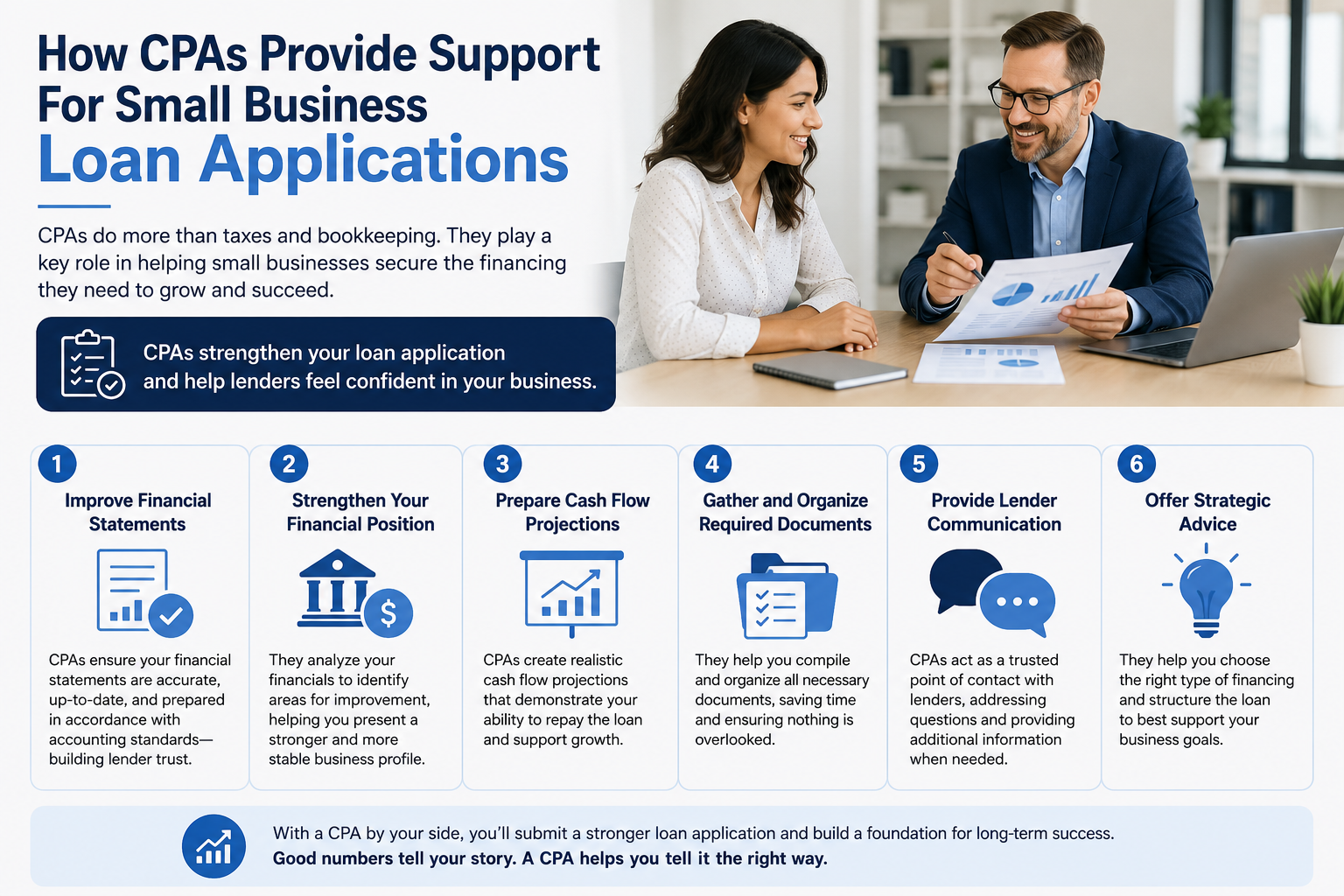
You might be feeling caught between two stories right now. In one story, your business is ready to grow. You can see the new equipment, the extra staff, the bigger space. In the other story, you are staring at loan forms, financial statements, and lender questions that all seem to speak a different language—and you’re realizing it might be time to find an accountant near League City.end
Maybe your bank has already asked for “projections,” “debt service coverage,” or “personal financial statements,” and you nodded along even though your stomach tightened. Maybe you tried to pull the numbers together yourself, then started worrying that one mistake could sink your application.
If that sounds familiar, you are not alone. Many capable owners are strong operators and salespeople, yet feel exposed when it comes to formal loan applications. The good news is that you do not have to carry this alone. A Certified Public Accountant can stand between you and the complexity, translate the numbers, and help shape a loan package that lenders can trust.
In simple terms, here is the path ahead. A CPA helps you understand what lenders really look for, cleans up and organizes your financials, builds realistic projections, and ties everything together into a clear story about your business. That story becomes the backbone of a stronger loan application, whether you are pursuing a traditional bank loan or an SBA 7(a) loan through programs like those described in the U.S. Small Business Administration 7(a) loan guidance.
Why does getting a business loan feel so hard, and where does a CPA fit in?
On the surface, a small business loan sounds simple. You apply, you share your numbers, the bank decides. In reality, it often feels like walking into an exam you never studied for. There are rules you have not seen, ratios you have never heard of, and a sense that everyone else knows something you do not.
Here is the core problem. Lenders do not just want to know if you have a good idea. They want to know, in numbers, whether you can pay them back on time, even if things do not go perfectly. That means they examine your financial statements, your tax returns, your cash flow, your existing debts, and your personal finances. If those pieces are incomplete, inconsistent, or confusing, the lender’s default reaction is to protect themselves and say no.
That is where the stress ramps up. You may start second guessing everything. Are last year’s books accurate enough. Will that slow quarter raise red flags. Does your tax return contradict your profit and loss report. The more you look, the more fragile it can all feel.
A CPA steps in here as both technician and translator. They understand what lenders and regulators care about, including standards such as the SBA’s rules on “credit elsewhere” documented in 13 CFR 120.191. They know how to turn your day-to-day records into financial statements that match those expectations. They also know how to explain your numbers in plain language so that your story makes sense to a loan officer who has never met you.
What specific challenges do CPAs help solve during loan applications?
To see how CPA support for small business loans works in practice, it helps to walk through some common problem areas.
Imagine you are applying for an SBA 7(a) loan to expand your shop. The bank asks for three years of financial statements, tax returns, year-to-date results, and projections for the next two years. You have a bookkeeping file, but it has not been carefully reviewed. There are personal expenses mixed in. Inventory numbers are estimated. Your tax returns tell one story. Your internal reports tell another.
A lender looking at that package may see risk and confusion. They might wonder if profits are overstated, if cash flow is reliable, or if the business can handle more debt. Even if your business is strong, the numbers do not show it clearly.
A CPA can step into this picture and:
- Clean up your historical financials so they match your tax returns and reflect reality.
- Separate business and personal transactions so the business performance is clear.
- Prepare formal financial statements that lenders recognize and trust.
- Build cash flow projections that connect to your past results and your growth plans.
There is also the emotional side. It is common to feel embarrassed about messy records or years where profits were thin. A good CPA does not judge. They work from where you are. They help you understand your numbers, not just present them. Resources such as CPA Australia’s guide to achieving financial success in business, which you can find in this financial success guide, echo the same idea. Clarity and structure reduce stress and improve decision making.
Because of this, you might wonder whether you should keep trying to manage the loan process on your own or bring in professional help.
Should you DIY your loan application or involve a CPA?
There is no one-size answer. Some owners with simple businesses and strong bookkeeping can manage a basic application on their own. Others benefit greatly from professional support. It helps to compare the two approaches side by side.
| Aspect | DIY Loan Application | Working With a CPA |
| Time required | High. You research requirements, fix records, and prepare documents yourself. | Lower. CPA handles technical work so you can focus on running the business. |
| Accuracy of financials | Depends on your accounting skills. Errors or gaps are more likely. | Higher. CPA is trained to prepare statements that align with lender expectations. |
| Understanding lender criteria | Relies on online research and guesswork about what matters most. | Stronger. CPA understands common lender ratios and SBA guidelines. |
| Stress level | Often high. You carry the burden and worry about missing something. | Lower. You share the responsibility with a professional advisor. |
| Cost | No direct fee, but significant time cost and possible rework. | Professional fee, but potential for faster approval and better structure. |
| Long term benefits | Limited. Focused on getting through a single application. | Stronger. Better systems, clearer numbers, and ongoing financial guidance. |
For many owners, the deciding factor is not just the loan outcome. It is the peace of mind that comes from having financial systems and reporting that continue to support the business after the loan is approved.
Guides like CPA Australia’s accessible fact sheet on applying for finance, which you can explore through this practical guide to applying, show how structured preparation can improve both your confidence and the lender’s confidence. A CPA helps turn that structure into your everyday reality.
What practical support can a CPA give you right now?
You might be wondering what working with a CPA would look like in concrete terms. Here are three focused actions you can take, with clear ways a CPA can support each one.
1. Get your historical numbers lender ready
Start by gathering the last three years of financial records and tax returns. Even if they are messy, bring everything to the table. A CPA can then:
- Reconcile your accounts so your balance sheet and income statement are accurate.
- Align your financial statements with your filed tax returns.
- Identify and explain one-time events or unusual swings that need context for a lender.
- Highlight key ratios such as profit margins and coverage of existing debt.
This turns a pile of records into a set of clean, consistent financial statements that support your small business loan support from CPAs strategy.
2. Build realistic, defensible projections
Lenders are not just lending to your past. They are lending to your future. A CPA can help you build projections that are grounded in your history and your actual plans.
- Translate your growth plans into numbers. New staff, higher rent, new equipment, and expected revenue.
- Model different scenarios, such as slower sales or higher costs, so you understand the risks.
- Prepare cash flow forecasts that show how you will make loan payments even in a softer period.
When a lender sees projections that connect clearly to past results and realistic assumptions, your application feels less like a wish and more like a plan.
3. Shape your narrative and prepare for lender questions
Numbers alone are not enough. Lenders want a clear story about who you are, what you do, why you need the money, and how you will repay it. A CPA can help you:
- Summarize your business model and revenue streams in a way that matches your financials.
- Explain any weak years or setbacks and show how things have changed.
- Prepare simple talking points for common lender questions about margins, cash flow, and risk.
This combination of clean numbers plus a clear story is what turns a basic application into a strong one. It also gives you more confidence in every meeting or call with a lender.
Moving forward with more clarity and less stress
Right now, the loan process may feel like a barrier between you and the next stage of your business. With the right support, it can become something else. It can become a chance to really understand your numbers, strengthen your systems, and present your business in the best possible light.
Whether you are applying for an SBA 7(a) loan or a different type of finance, working with a CPA can transform a confusing, draining process into a more guided, thoughtful one. The goal is not perfection. The goal is clarity, consistency, and a story that makes sense to you and to your lender.
You do not have to carry this alone. Start by talking with a Certified Public Accountant about your plans, your concerns, and your timelines. Share where you feel stuck. From there, you can decide together how much support you need, from cleaning up your books to building full lender-ready packages. Your business deserves that level of care, and so do you.