 By admin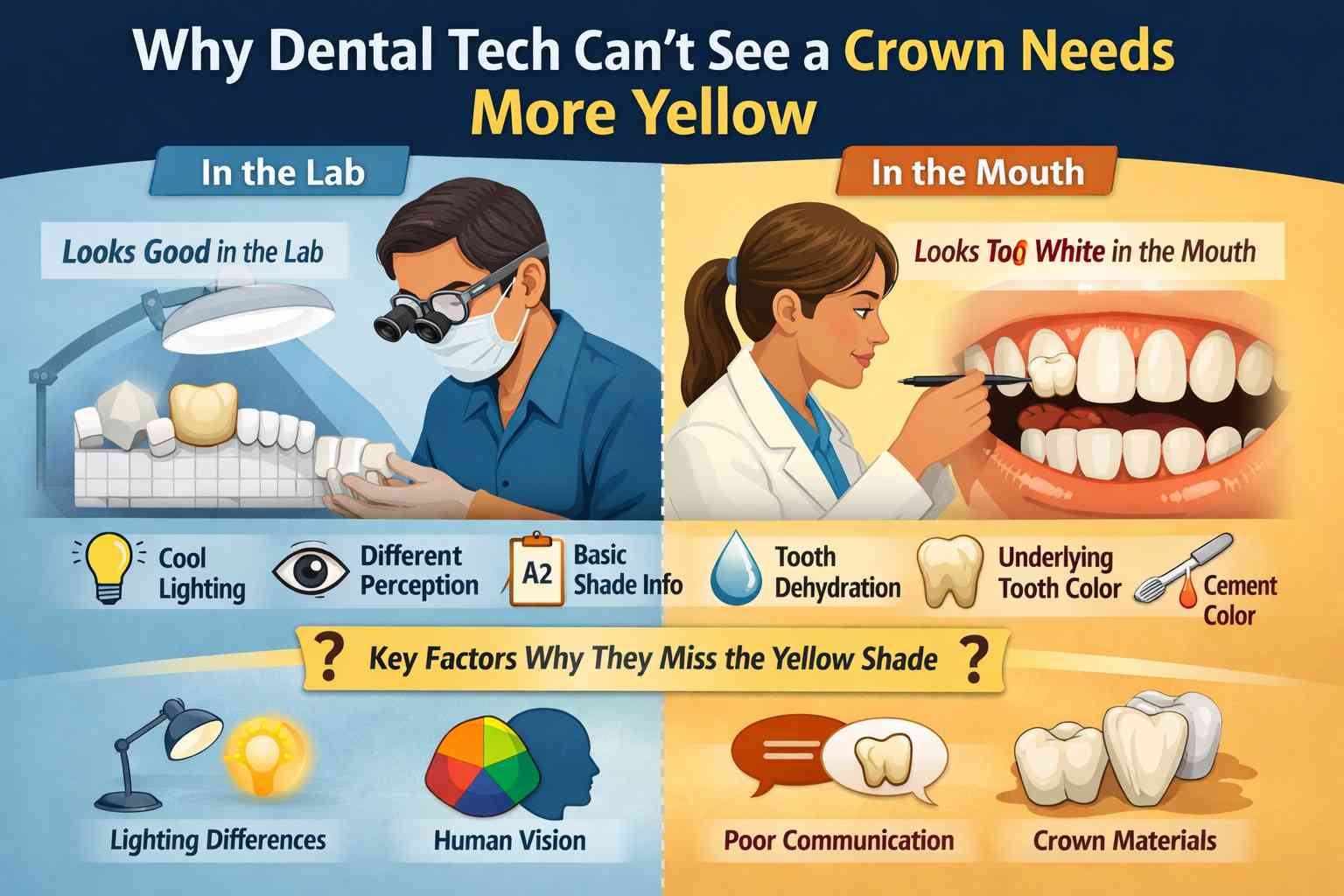
Dental crowns are made to look like natural teeth. The goal is for the crown to blend in so well that no one can tell the difference. However, a common problem happens when a dentist places a crown and notices that the crown looks too white, gray, or cold compared to nearby teeth.
In these situations, dentists often say:
“The crown needs more yellow.”
This can be confusing for dental technicians. From their point of view in the lab, the crown may look correct. But once it is placed in the patient’s mouth, the color may look different. There are many reasons why this happens. The issue is usually not one mistake. Instead, it is caused by lighting, human vision, communication problems, tooth conditions, and dental materials.
This article explains the main reasons why a dental tech may not see that a crown needs more yellow.
What “More Yellow” Means in Dental Shades
When dentists say a crown needs more yellow, they are talking about tooth color characteristics.
In dentistry, tooth color has three main parts.
| Color Term | Simple Meaning | How It Affects the Crown |
|---|---|---|
| Hue | The basic color family | Teeth are usually yellow or yellow-red |
| Chroma | How strong the color is | Higher chroma means stronger yellow |
| Value | How light or dark the tooth looks | Higher value means whiter teeth |
Most natural teeth belong to the yellow color family. When a crown looks too white or gray, it usually means the crown does not have enough yellow chroma.
Dentists may describe this problem in different ways:
-
Too white
-
Too gray
-
Too cool
-
Not warm enough
All of these usually mean the crown needs more yellow color.
Lighting Is the Biggest Reason for Shade Problems
Lighting plays a huge role in how we see tooth color.
A crown can look perfect in the dental lab but look different in the patient’s mouth because the lighting is different.
This effect is called metamerism.
Metamerism means a color can look different under different lights.
Common Lighting in Dentistry
| Location | Type of Light | How It Changes Color |
|---|---|---|
| Dental lab | Cool LED bench lights | Yellow tones may look weaker |
| Dental office | Strong dental lights | Colors may look washed out |
| Natural daylight | Sunlight | Shows the most natural color |
| Phone camera flash | Artificial light | May make teeth look whiter |
Because the lab and clinic use different lights, the dental technician might not see the same color problem the dentist sees.
Yellow tones are especially sensitive to lighting changes.
People See Color Differently
Another reason for color differences is human vision. Two people can look at the same tooth and see slightly different colors. Our eyes adjust to light and surrounding colors very quickly.
Things That Affect How We See Tooth Color
-
Eye fatigue from looking too long
-
Bright lights in the room
-
Colorful surroundings
-
Contrast with nearby teeth
Environmental Colors That Can Affect Shade
| Factor | Effect on Tooth Color |
|---|---|
| Bright lipstick | Teeth may look more yellow |
| Colorful clothes | Changes color perception |
| Operatory wall colors | Can warm or cool the shade |
| Dental bib color | May affect contrast |
For this reason, many dentists use neutral gray backgrounds when checking tooth color.
Poor Communication Between Dentist and Lab
Another big reason why dental techs may miss the yellow tone is limited shade information.
Many dentists send a lab prescription with only a shade like:
-
A1
-
A2
-
B1
-
A3
However, real teeth are more complex than a single shade.
Natural teeth have different colors in different areas, such as:
-
Warmer color near the gums
-
Different color in the middle of the tooth
-
More translucent tips
Common Shade Communication Problems
Dentists sometimes send unclear instructions such as:
-
“Too gray”
-
“Add yellow”
-
“Make it warmer”
These descriptions can be hard for technicians to translate into exact lab changes.
Information That Helps the Lab
| Information Sent to Lab | Why It Helps |
|---|---|
| Shade tab photos | Shows exact comparison |
| Photos from different angles | Shows color areas |
| Notes about tooth sections | Explains where color changes |
| Stump shade | Shows color of prepared tooth |
Better communication helps the technician understand how much yellow is needed.
Tooth Dehydration Can Change Tooth Color
Teeth can temporarily change color during dental treatment. When teeth dry out, they become lighter and less yellow. This is called tooth dehydration. It happens during dental work because teeth are exposed to air.
Causes of Tooth Dehydration
-
Air drying
-
Cotton isolation
-
Suction
-
Long appointments
How Dehydration Changes Tooth Color
| Tooth Condition | Appearance |
|---|---|
| Normal hydrated tooth | Natural yellow tone |
| Slight dehydration | Looks whiter |
| Severe dehydration | Looks chalky or pale |
If a dentist takes the shade after the tooth dries, the chosen shade may be too white. Later, when the tooth becomes hydrated again, the natural yellow color returns, and the crown may look too gray.
Best Practice
Shade selection should be done early in the appointment before the teeth dry out.
The Prepared Tooth Can Affect Crown Color
The color of the tooth under the crown also affects the final shade.
This is called the stump shade.
Some dental materials are slightly transparent, so the underlying tooth color can show through.
How Stump Shade Affects the Crown
| Stump Color | Effect on Crown |
|---|---|
| Light tooth | Little effect |
| Yellow dentin | Makes crown warmer |
| Dark tooth | Can darken crown |
| Metal core | Needs masking |
If the lab does not know the stump shade, the technician may design the crown incorrectly.
Cement Color Can Change the Crown Shade
Dental cement also affects the final color of the crown.
Some crowns allow light to pass through them. This means the cement color can change how the crown looks.
Common Cement Shades
| Cement Color | Effect |
|---|---|
| Clear | Minimal color change |
| White | Makes crown look brighter |
| Yellow | Adds warmth |
| Opaque | Blocks underlying tooth color |
If the cement used during placement is different from what the lab expected, the crown color may change.
Crown Material Also Matters
Different crown materials behave differently with light.
Some materials are more transparent, while others are more opaque.
Common Crown Materials
| Material | Transparency | Effect on Shade |
|---|---|---|
| Zirconia | More opaque | Hides underlying color |
| Lithium disilicate | More translucent | Shows natural tooth color |
| Layered porcelain | Variable | Allows custom shading |
Crown thickness also affects the final appearance.
-
Thin crowns allow underlying color to show through.
-
Thick crowns may look flat or less natural.
Cameras Can Change Tooth Color in Photos
Today dentists often send photos to dental labs for shade communication.
However, cameras do not always capture colors correctly.
Smartphones automatically adjust:
-
White balance
-
Brightness
-
Color temperature
These adjustments can remove yellow tones from photos.
Common Photo Problems
| Problem | Result |
|---|---|
| Auto white balance | Reduces yellow color |
| Flash reflection | Loss of detail |
| Overexposed image | Teeth look too white |
| Different phone screens | Colors look different |
Tips for Better Shade Photos
-
Use consistent lighting
-
Include a shade tab in the photo
-
Keep the shade tab next to the tooth
-
Avoid heavy flash
These steps help technicians see the true tooth color.
How to Clearly Tell the Lab a Crown Needs More Yellow
Instead of vague descriptions, dentists can give clear instructions.
Better Shade Instructions
Examples include:
-
Increase yellow color near the gums
-
Add yellow modifiers in the middle of the crown
-
Reduce gray tones
-
Keep brightness but add warmth
Clear instructions make it easier for the lab to adjust the crown.
Best Practices to Avoid Shade Problems
Good teamwork between the dentist and dental lab can prevent many crown shade problems.
Chairside Steps
-
Choose shade early in the appointment
-
Check shade under different lighting
-
Use neutral backgrounds
-
Take clear photos
-
Record stump shade
Laboratory Steps
-
Confirm shade details
-
Ask for more photos if needed
-
Check crowns under different lights
-
Use proper staining and layering
Conclusion
When a crown appears to need more yellow, the issue is rarely caused by just one factor. Many things can affect crown color, including:
-
Lighting differences
-
Human vision
-
Shade communication problems
-
Tooth dehydration
-
Stump shade
-
Cement color
-
Crown materials
-
Photography limitations
Because shade matching involves both science and visual judgment, good communication between dentists and dental technicians is very important.
When both sides share clear information and follow good shade-matching practices, it becomes much easier to create crowns that look natural and match the patient’s smile.