 By admin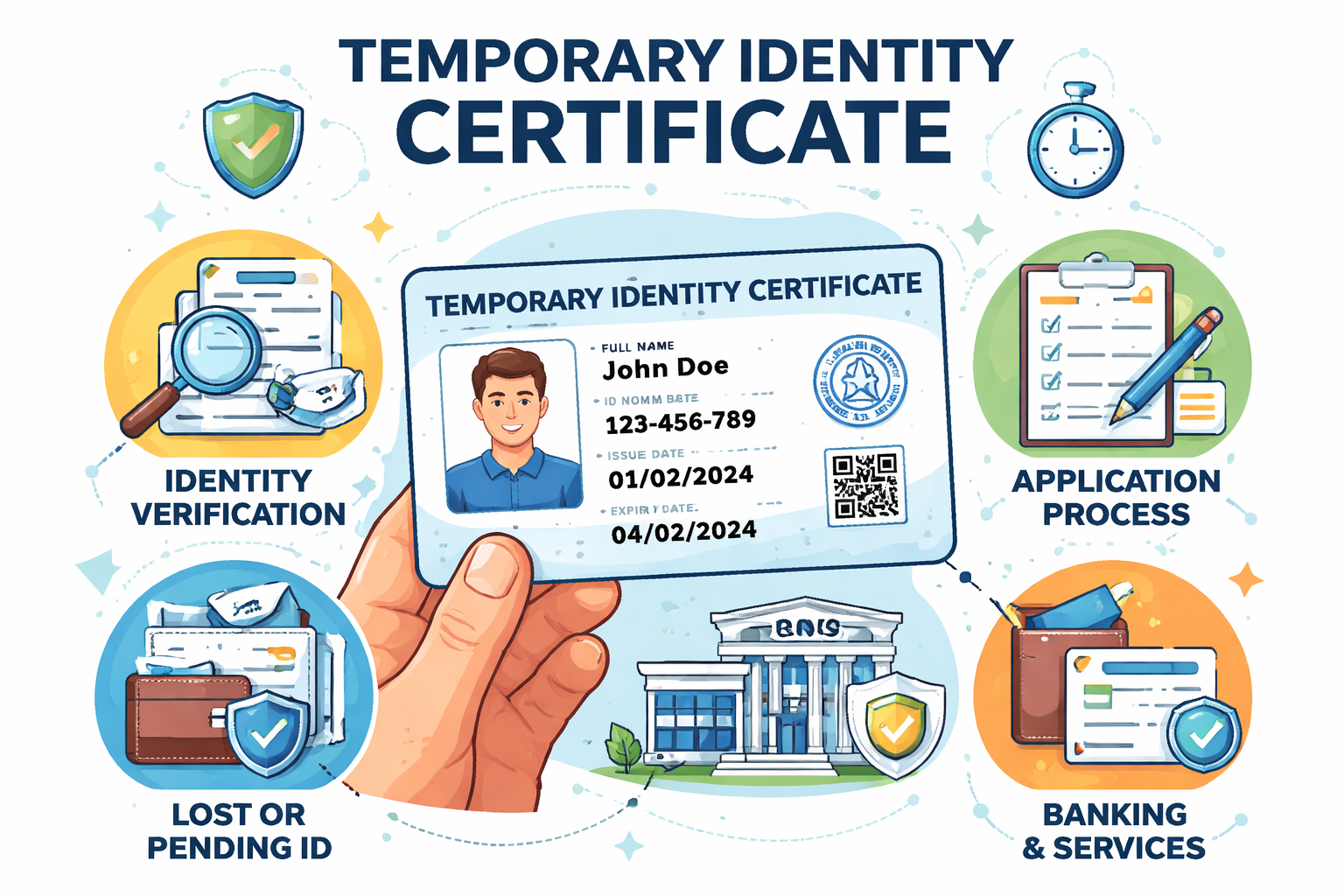
Identity documents are very important in everyday life. Governments, banks, schools, hospitals, and many other organizations require people to show proof of identity before they can receive services. Normally, people use permanent identity documents such as a national ID card, passport, or residence permit. However, sometimes people may not have their permanent ID with them. It may be lost, stolen, damaged, or still being processed by authorities. In these situations, a Temporary Identity Certificate can help. A Temporary Identity Certificate (TIC) is an official document that proves a person’s identity for a short period of time until their permanent identification is available. This article explains everything about Temporary Identity Certificates, including their meaning, purpose, application process, required documents, validity, uses, and limitations.
What Is a Temporary Identity Certificate?
A Temporary Identity Certificate is a short-term identity document issued by a government department or authorized organization. It helps confirm a person’s identity when their permanent identification document is not available.
This certificate works as a temporary replacement for documents such as:
-
National ID card
-
Passport
-
Residence permit
-
Government registration documents
People usually receive this certificate when they are waiting for their permanent ID or when their identification document has been lost or damaged.
Key Features of a Temporary Identity Certificate
| Feature | Description |
|---|---|
| Type | Temporary identification document |
| Issued By | Government or authorized office |
| Purpose | Short-term identity verification |
| Validity | Limited time period |
| Usage | Access to services and official procedures |
Purpose of a Temporary Identity Certificate
The main purpose of a Temporary Identity Certificate is to help people prove their identity while waiting for their permanent identification document.
Main Purposes
-
Identity Verification
It confirms the identity of a person when their official ID is not available. -
Access to Important Services
It allows people to use services like banking, healthcare, or education. -
Completing Official Procedures
Many government and legal procedures require identity verification. -
Temporary Replacement of Lost Documents
It acts as temporary proof while a replacement ID is being prepared.
Situations When a Temporary Identity Certificate Is Issued
Authorities may issue a Temporary Identity Certificate in different situations.
Common Situations
-
When an ID card or passport is lost or stolen
-
When someone applies for a new national ID card
-
When a document is damaged or expired
-
When permanent identification is still under processing
-
During emergency situations such as displacement or disasters
Example Situations
| Situation | Reason |
|---|---|
| Lost ID card | Replacement process has started |
| First-time ID application | Waiting for permanent ID |
| Damaged document | Temporary proof required |
| Emergency cases | Immediate identity verification |
Who Can Apply for a Temporary Identity Certificate?
Different people may be eligible to apply for a Temporary Identity Certificate depending on government rules.
Common Eligible Applicants
-
Citizens waiting for their first national ID
-
People who lost their identity documents
-
Residents waiting for verification of their records
-
Employees registered in certain government programs
-
Students needing identity verification for school records
Eligibility Table
| Applicant | Reason |
|---|---|
| Citizens | Waiting for permanent ID |
| Residents | Documents under review |
| Employees | Workplace registration |
| Students | Education verification |
Information Included in a Temporary Identity Certificate
A Temporary Identity Certificate contains basic personal information to confirm a person’s identity.
Common Details in the Certificate
-
Full name
-
Date of birth
-
Identification number
-
Residential address
-
Photograph
-
Issuing authority
-
Issue date
-
Expiry date
-
Official stamp or signature
Example Certificate Information
| Field | Description |
|---|---|
| Name | Full legal name |
| Date of Birth | Person’s birth date |
| ID Number | Unique identity number |
| Address | Home address |
| Issue Date | Date of certificate issuance |
| Expiry Date | Date when certificate becomes invalid |
Some modern certificates also include QR codes or digital verification features to improve security.
Validity Period of a Temporary Identity Certificate
A Temporary Identity Certificate is only valid for a limited time.
Usually, the validity period ranges from:
-
30 days
-
60 days
-
90 days
-
Up to 6 months
Validity Comparison
| Document Type | Validity |
|---|---|
| Temporary Identity Certificate | 1–6 months |
| Permanent ID Card | 5–10 years |
When the permanent identity document is issued, the temporary certificate is no longer needed.
How to Apply for a Temporary Identity Certificate
The process of applying for a Temporary Identity Certificate is usually simple.
Application Steps
-
Submit an Application
Visit the government office or apply online. -
Provide Required Documents
Submit proof of identity and other documents. -
Verification Process
Authorities verify your personal information. -
Certificate Issuance
The temporary certificate is issued after verification.
Application Process Table
| Step | Action |
|---|---|
| Step 1 | Submit application |
| Step 2 | Provide documents |
| Step 3 | Identity verification |
| Step 4 | Receive certificate |
In some countries, people can complete the process through online government portals.
Required Documents for Application
Applicants usually need to provide some documents when applying for a Temporary Identity Certificate.
Common Required Documents
-
Completed application form
-
Previous identity document (if available)
-
Birth certificate
-
Proof of address
-
Passport-size photographs
-
Employer or institution verification (if required)
Required Documents Table
| Document | Purpose |
|---|---|
| Application Form | Official request |
| Previous ID | Identity proof |
| Birth Certificate | Verify date of birth |
| Address Proof | Confirm residence |
| Photos | Visual identification |
Providing correct documents helps authorities process the application quickly.
Uses of a Temporary Identity Certificate
A Temporary Identity Certificate can be used in many situations while waiting for permanent identification.
Common Uses
-
Access government services
-
Open or verify bank accounts
-
Confirm identity for employment
-
Enroll in educational institutions
-
Register for healthcare services
-
Complete legal or administrative procedures
Service Use Table
| Service | How the Certificate Helps |
|---|---|
| Banking | Identity verification |
| Healthcare | Patient registration |
| Education | Admission confirmation |
| Government Services | Official procedures |
Limitations of Temporary Identity Certificates
Although helpful, Temporary Identity Certificates also have some limitations.
Main Limitations
-
Valid for a short time only
-
Not accepted by all institutions
-
Cannot be used for international travel
-
Must eventually be replaced by a permanent ID
Limitations Table
| Limitation | Explanation |
|---|---|
| Short Validity | Only temporary use |
| Limited Acceptance | Some institutions require permanent ID |
| No Travel Use | Not accepted for international travel |
Because of these limitations, it is important to obtain a permanent identity document as soon as possible.
Security Features of Temporary Identity Certificates
To prevent fraud and identity misuse, temporary certificates may include security features.
Common Security Features
-
Official government seal
-
Unique certificate number
-
QR code for digital verification
-
Photograph of the holder
-
Connection to government databases
Security Features Table
| Feature | Purpose |
|---|---|
| QR Code | Quick verification |
| Official Seal | Authenticity confirmation |
| Unique Number | Identification tracking |
| Photo ID | Visual identity verification |
Digital Temporary Identity Certificates
Many countries are now introducing Digital Temporary Identity Certificates. These certificates can be accessed through mobile apps or online government portals.
Advantages of Digital Certificates
-
Faster identity verification
-
Easy access using smartphones
-
Secure digital authentication
-
Reduced paperwork
Digital vs Physical Certificate
| Feature | Digital Certificate | Physical Certificate |
|---|---|---|
| Format | Electronic | Paper document |
| Access | Mobile devices | Physical copy |
| Verification | Online system | Manual check |
Digital identity systems make identity verification faster and more secure.
Conclusion
A Temporary Identity Certificate is an important document that helps people prove their identity when their permanent identification is not available. It allows individuals to access services such as healthcare, education, banking, and government procedures while waiting for their official ID documents. Although this certificate is only valid for a short period and has certain limitations, it plays a very important role in ensuring that people can continue their daily activities without interruption. As technology improves, many governments are also introducing digital temporary identity certificates, making identity verification easier, faster, and more secure for everyone.