 By admin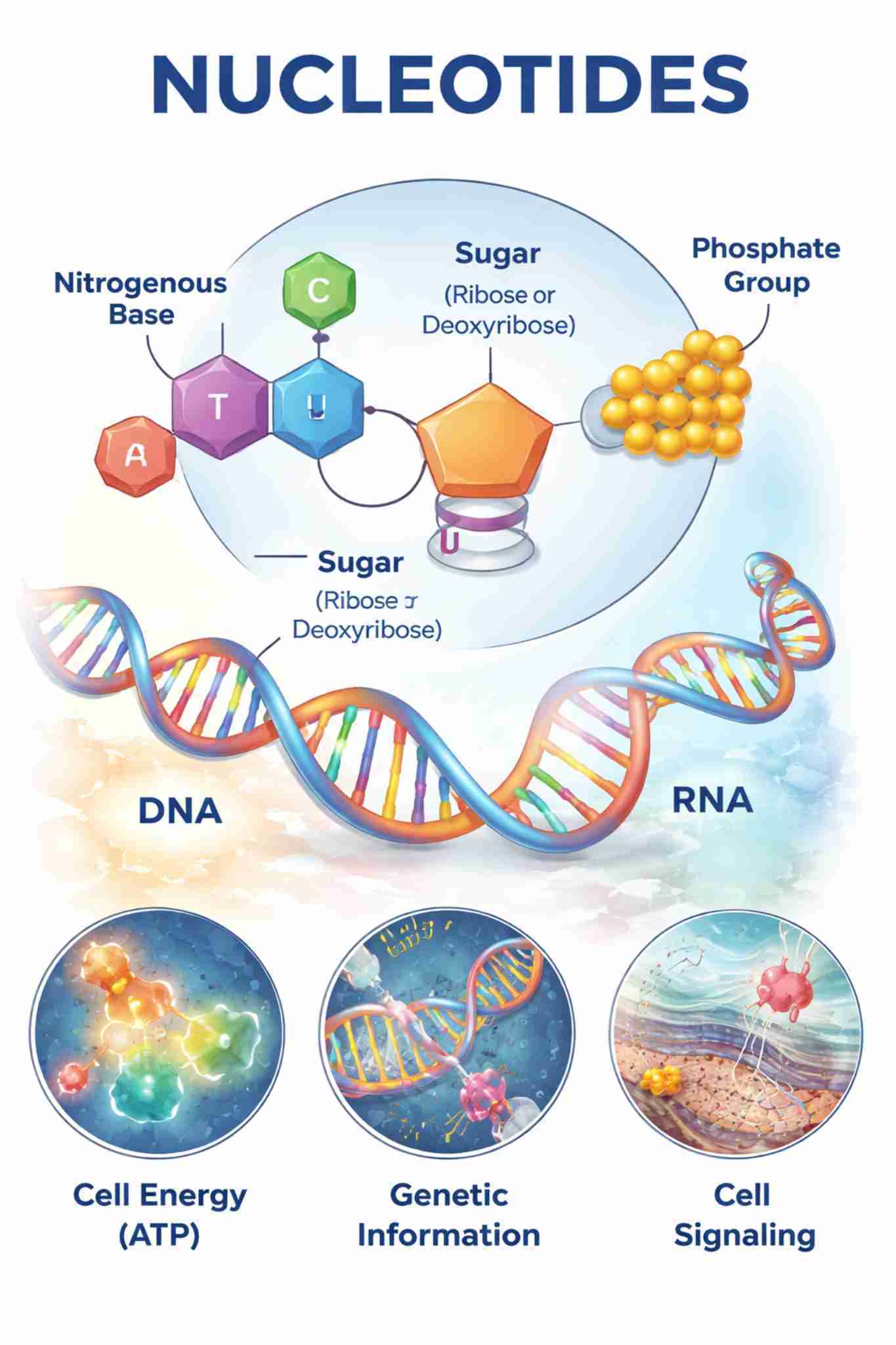
Nucleotides are very small molecules, but they are extremely important for life. Every cell in the human body needs nucleotides to work properly. They help store genetic information, give energy to cells, and control many processes inside the body. Without nucleotides, there would be no DNA, no RNA, and no normal cell activity.
In this article, you will learn what nucleotides are, how they are built, what they do in the body, where we get them from, and when they may be useful for health.
What Are Nucleotides?
A nucleotide is a small organic molecule that is a basic unit of DNA and RNA. DNA and RNA are long chains made from many nucleotides linked together. The order of these nucleotides carries genetic information. This information tells the body how to grow, develop, and function.
It is important to know the difference between:
-
Nucleoside – base + sugar
-
Nucleotide – base + sugar + phosphate group
The phosphate group is what makes a nucleoside into a nucleotide and allows nucleotides to join together in long chains.
Structure of a Nucleotide
Each nucleotide has three main parts:
-
Nitrogen base
-
Adenine (A)
-
Guanine (G)
-
Cytosine (C)
-
Thymine (T – in DNA)
-
Uracil (U – in RNA)
-
-
Sugar
-
Deoxyribose (in DNA)
-
Ribose (in RNA)
-
-
Phosphate group
-
Helps nucleotides connect to each other
-
Important for energy transfer in cells
-
Table 1. DNA vs RNA Nucleotides
| Feature | DNA | RNA |
|---|---|---|
| Sugar type | Deoxyribose | Ribose |
| Bases used | A, G, C, T | A, G, C, U |
| Main role | Stores genetic info | Helps make proteins |
| Stability | More stable | Less stable |
Types of Nucleotides
Nucleotides can be grouped in different ways.
By their role in the body:
-
DNA and RNA nucleotides – build genetic material
-
Energy nucleotides – give energy to cells (for example ATP)
-
Signal nucleotides – help send messages inside cells
-
Coenzyme nucleotides – help chemical reactions in the body
Table 2. Examples of Important Nucleotides
| Nucleotide | Full Name | Main Role in the Body |
|---|---|---|
| ATP | Adenosine triphosphate | Main energy source for cells |
| GTP | Guanosine triphosphate | Helps in protein making |
| cAMP | Cyclic AMP | Cell signaling |
| NAD⁺ | Nicotinamide adenine dinucleotide | Helps in energy reactions |
| FAD | Flavin adenine dinucleotide | Helps in cell breathing |
Main Functions of Nucleotides
Nucleotides have many important jobs in the body.
The most important functions include:
-
Building DNA and RNA
-
DNA stores genetic information
-
RNA helps read this information and make proteins
-
-
Providing energy
-
ATP is the main energy source for all cells
-
Energy from ATP is used for:
-
Muscle movement
-
Nerve signals
-
Transport of substances in cells
-
-
-
Cell communication
-
Some nucleotides help cells send signals to each other
-
-
Helping chemical reactions
-
Some nucleotides are part of enzymes and coenzymes
-
They help many chemical reactions happen faster
-
Read also: Speciation
How the Body Makes and Reuses Nucleotides
The human body can make its own nucleotides. This is very important because every day cells need new DNA, RNA, and energy.
Main ways the body gets nucleotides:
-
Making them from scratch (de novo synthesis)
-
The body builds nucleotides from small basic molecules
-
This process needs energy
-
-
Reusing parts (salvage pathway)
-
The body recycles bases from old DNA and RNA
-
This saves energy
-
-
Breaking them down
-
Old or damaged nucleotides are broken into smaller parts
-
Some waste products are removed from the body
-
Nucleotides in Food
We get some nucleotides from food, but our body can also make them on its own.
Foods that naturally contain nucleotides:
-
Meat
-
Fish
-
Eggs
-
Beans and lentils
-
Yeast
-
Breast milk (for babies)
Table 3. Nucleotides in Diet – Who May Need More?
| Group of People | Importance of Nucleotides in Diet |
|---|---|
| Healthy adults | Body usually makes enough |
| Babies and children | Higher needs during growth |
| People after illness | Needs may be higher during recovery |
| Athletes | Higher energy use |
Nucleotides and the Immune System
The immune system protects the body from infections. Immune cells grow and divide quickly, especially during illness. Because of this, they need a lot of nucleotides to make new DNA and RNA.
Nucleotides may help:
-
Support immune cell growth
-
Help repair tissues
-
Support gut cells, which renew very fast
For most healthy adults, the body can make enough nucleotides. In special cases (for example during recovery from illness), needs may be higher.
Nucleotide Supplements – Are They Needed?
Some food supplements contain nucleotides. They are often sold as products to support:
-
Immunity
-
Energy
-
Recovery
-
Gut health
Important points to remember:
-
Supplements are not needed for most healthy people
-
A balanced diet is usually enough
-
Too much of some nucleotide products may not be good for health
-
Always talk to a doctor or dietitian before using supplements
Common Myths About Nucleotides
❌ Myth: The body cannot make nucleotides on its own
✅ Fact: The body can make nucleotides every day
❌ Myth: Nucleotides are only for immune support
✅ Fact: They are needed for DNA, energy, and many cell functions
❌ Myth: More nucleotides always means better health
✅ Fact: Balance is important; too much is not always good
Summary – Key Points
Nucleotides are:
-
The building blocks of DNA and RNA
-
A main source of energy for cells
-
Important for cell signals and metabolism
-
Needed for growth, repair, and normal body function
Even though they are tiny molecules, nucleotides are one of the most important parts of life at the cellular level. Understanding how they work helps us better understand how the human body functions every day.